
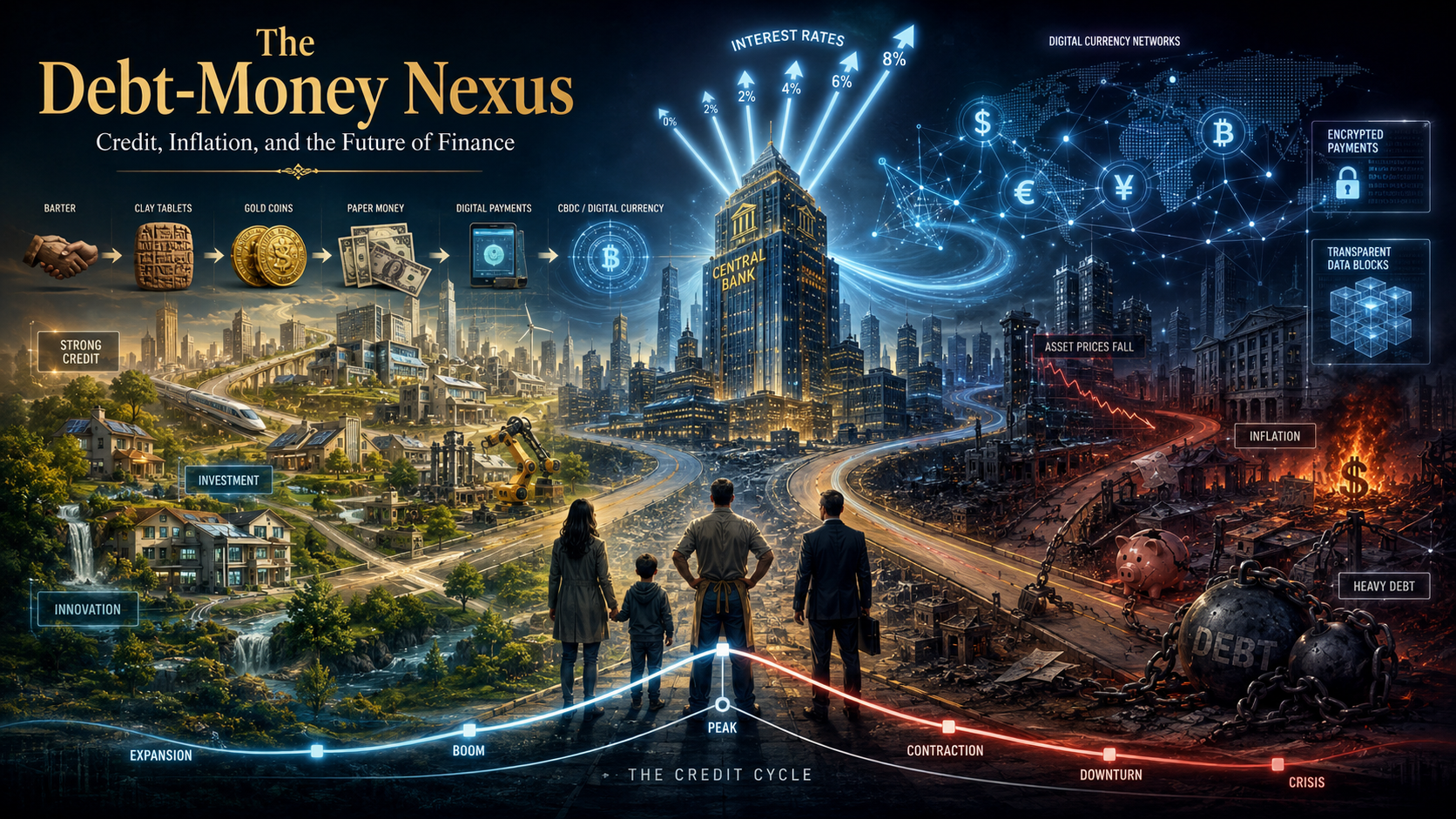
Overview

The Debt-Money Nexus: Navigating Credit Cycles, Inflation, and the Future of Finance

Introduction: Why Debt-Based Money Matters Now Money is often treated as a neutral tool: a medium of exchange, a unit of account, and a store of value. Debt, by contrast, is usually discussed as a burden carried by households, firms, or governments. Yet in modern financial systems, money and debt are not separate phenomena. They […]


Unmasking the Debt Trap: Money Creation, Inflation, and the Future of Financial Freedom

Introduction: Why Money Creation Matters Money feels simple when we use it. We earn it, spend it, borrow it, save it, and lose sleep over it. Yet behind every payment, mortgage, government budget, and interest-rate decision lies a system most citizens never truly see: the modern monetary machine. In a recent discussion on Wolfgang Wee […]

ReDigitalBeing / RoomZero: Building a Responsible Digital-Being Simulation Platform for the Agentic AI Era

Introduction: Why ReDigitalBeing Matters Now ReDigitalBeing is best understood as a research-oriented attempt to answer one of the most important questions in contemporary artificial intelligence: how can we build persistent, emotionally coherent, memory-aware digital beings without pretending they are conscious, uncontrolled, or ethically neutral? Its current technical core, RoomZero, is described in the project repository […]

Charging Europe’s Electric Future: Market Revenue, Infrastructure, and the 2026–2030 Outlook for EV Charging

Introduction: Why EV charging has become a strategic European market Electric vehicle charging in Europe has moved from a niche infrastructure question to a central pillar of industrial policy, climate strategy, energy planning, consumer confidence, and private investment. A decade ago, the public conversation around electric vehicles focused mainly on vehicle range, battery cost, and […]

The Cosmos, the Energies, and the Music

A Guide to the Universe as Matter, Motion, Vibration, and Meaning Introduction: Is the Universe Singing? The idea that the cosmos has music is ancient, beautiful, and surprisingly modern. For thousands of years, philosophers, mystics, mathematicians, astronomers, and musicians have imagined the universe as an ordered harmony: planets moving in ratios, stars pulsing like instruments, […]

Deep Research Brief: The Potential of Mycelium

Executive Summary Mycelium has large potential, but not in one single “miracle” direction. Its strongest near-term potential is in soil health, ecological restoration, sustainable packaging, insulation, alternative protein, enzyme production, and selected bioremediation uses. Its more speculative potential lies in structural building materials, leather-like fashion materials, living electronics, large-scale carbon sequestration, and “wood-wide web” forest […]

Let AI Do the Screen Work: Why Computer Technology Should Serve Human Time in Nature

Introduction: The Point of Technology Is Not More Screens The central promise of technology has always been liberation: fewer hours spent on repetitive labor, more capacity for thought, creativity, relationships, and contact with the living world. Yet the computer age has often produced the opposite. Instead of machines quietly handling routine work in the background, […]

Auditing the Latest BCI Breakthroughs: What Has Actually Changed, What Still Fails, and Why This Moment Matters

Introduction Brain-computer interfaces, or BCIs, are often described in language that is either embarrassingly inflated or embarrassingly outdated. In one direction lies the fantasy of effortless “mind reading.” In the other lies the stale assumption that BCIs are still little more than laboratory cursor tricks with no serious translational future. Both views are wrong. The […]

Personalized Gene Editing: A Game Changer for Ultra-Rare Disorders

Introduction Personalized gene editing sits at the edge of a profound shift in medicine. For decades, the treatment of genetic disease has been constrained by a hard economic and scientific reality: the rarer the mutation, the less likely it is that a conventional drug-development model will produce a therapy. Pharmaceutical pipelines have historically favored diseases […]

Norway’s Energy Policy: Achieving Climate Targets with TEK26

How Norwegian energy policy and “TEK26” can work together to hit climate targets On a dark January afternoon, Norway’s energy story becomes almost tactile. You feel it in the hum of ventilation fans, in the heat that leaks through an aging window frame, in the electric load that surges when temperatures drop and everyone—homes, schools, […]

Ultra-Processed Foods: The New Focus of Nutrition Policy

Ultra-Processed Foods Chapter 2. What counts as ultra-processed food (and why definitions cause arguments) If Chapter 1 was the “why now,” Chapter 2 is the “what exactly.” And here’s the uncomfortable truth: the argument over ultra-processed food is, first and foremost, an argument over definitions. That may sound like academic hair-splitting. But realize that definitions […]

Optimizing Energy Performance with Digital Twins in Norwegian Buildings

This case study illustrates the application of a digital twin in Norway’s building sector, addressing compliance with TEK17 and NS 3701 regulations. The approach ensures continuous monitoring of energy performance, offering improvements like energy savings and enhanced comfort. It aligns with future TEK26 goals for greater digital regulation and automatic compliance checks.

Embodied Carbon: The Future of Construction Decision-Making

The architecture sector is shifting focus from operational to embodied carbon in building materials, driven by a new AI-powered sustainable materials platform. This platform integrates design, carbon metrics, and supply chain realities, reducing friction in material selection while optimizing for sustainability, cost, and performance. Its effectiveness will shape the industry as regulatory demands increase.

Embrace 2026: Aligning Goals with Global Trends

The opening months of 2026 present a crucial opportunity for strategic planning amidst modest global growth and rapid technological advancements, especially in AI. Effective preparation involves aligning personal, professional, and ethical goals with significant trends. This structured approach emphasizes resilience, sustainability, and mindful reflection, fostering intentional actions for the decade ahead.

Right to Repair: A Shift Toward Sustainable Consumerism

The EU’s Right to Repair movement aims to combat the throwaway culture prevalent in consumer goods by promoting repairability and extending product lifespans. New regulations encourage manufacturers to provide spare parts, repair information, and incentives for consumers to choose repair over replacement. This shift fosters sustainability and reshapes ownership values in society.

AI Data Centers: The Power Demand Dilemma

This article discusses the growing electricity demand from AI data centers, which are reshaping power grids and spurring investment in on-site generation and older power plants. It highlights the challenges of interconnection queues and community pushback against fossil fuel use, emphasizing the need for a balanced approach to energy and technology planning moving forward.

Revolutionizing Connectivity: Direct-to-Cell Satellites Explained

The advent of direct-to-cell (D2C) satellite technology promises to eliminate mobile coverage gaps by connecting standard smartphones directly to satellites. Major companies are now deploying D2C services, ensuring connectivity in remote areas, enhancing emergency communications, and expanding access to underserved populations. This shift aims to turn the concept of “no dead zones” into a tangible reality.

Navigating the EU AI Act: Key Compliance Dates and Implications

The EU Artificial Intelligence Act is a significant regulatory framework, entering into force on August 1, 2024, and establishing compliance milestones through 2026. It categorizes AI systems based on risk levels, enforces bans on harmful practices, and aims to establish responsible AI governance globally, impacting organizations and innovation within and beyond Europe.

Understanding Yule: A Journey Through History and Modern Practices

The article explores the significance of “Yule tider,” tracing its origins from pre-Christian Germanic and Norse traditions through Christianization to modern global practices. It highlights Yule’s role in community bonding during winter’s darkness and addresses contemporary challenges like commercialization and environmental impact while emphasizing the adaptability and evolving meanings of Yuletide traditions today.

Understanding Embodied Carbon in Concrete: A Key Design Variable

The article discusses the increasing importance of embodied carbon in concrete, especially as operational energy efficiency improves. It focuses on the shift towards low-carbon materials, like geopolymers and alternative binders, driven by European policies and market demand. Strategies for effective CO₂ budgeting in design and construction practices are highlighted for engineers.

Transforming Compliance: From Burden to Integrated Design

The article discusses transforming compliance from a burdensome afterthought into an integral part of organizational architecture through a compliance-by-design pipeline. Key components include automating policy enforcement, ensuring traceability of actions, and creating reusable documentation. This approach promotes efficiency, reduces duplication, and fosters continuous improvement, ultimately enhancing organizational trust and compliance management.

Transforming Construction with Agentic AI: A Comprehensive Guide

Agentic AI has evolved from conversational systems to autonomous agents capable of performing significant operational tasks. This shift raises new risks related to governance, accountability, and cybersecurity. As organizations, especially in construction, adopt agentic AI, they must establish robust frameworks for oversight, transparency, and compliance to ensure safety and manage systemic risks effectively.

The Quantum Mechanics Revolution: 100 Years of Innovation

Quantum mechanics, established in 1925, transformed from patchwork models to a robust theory, impacting technology such as transistors and lasers. Its precision and inherent uncertainties drive ongoing debates about measurement and reality. Emerging fields like quantum computing and secure communication reflect the theory’s dual-use challenge amid significant scientific and strategic implications.

Navigating Change: 10 Essentials for 2026

By 2026, geo-economic fragmentation, climate issues, and tech changes will demand strategic actions across ten key domains, promoting resilience, adaptability, and impact. Individuals must reassess goals, enhance financial security, deepen digital literacy, prioritize health, and engage with local and global contexts. Active foresight and creative contributions will be essential for navigating uncertainty.

Share with