

Philosophy

Tachyons: Faster-Than-Light Particles, Quantum Instabilities, and the Physics Beyond the Light Barrier

Abstract Few concepts in theoretical physics occupy as unusual a position as the tachyon. Originally proposed as a hypothetical particle that could move faster than light, the tachyon quickly became associated with some of the deepest questions in relativity: whether the speed of light is an absolute barrier, whether cause must precede effect for every […]

Spacetime from Entanglement: Is the Universe Built Like a Quantum Error-Correcting Code?

How Quantum Information Is Reshaping Our Understanding of Geometry, Gravity, and the Architecture of Reality Abstract For more than a century, spacetime has occupied a foundational role in physics. General relativity describes gravity not as a conventional force but as the curvature of spacetime itself, while quantum field theory ordinarily assumes a spacetime background on […]

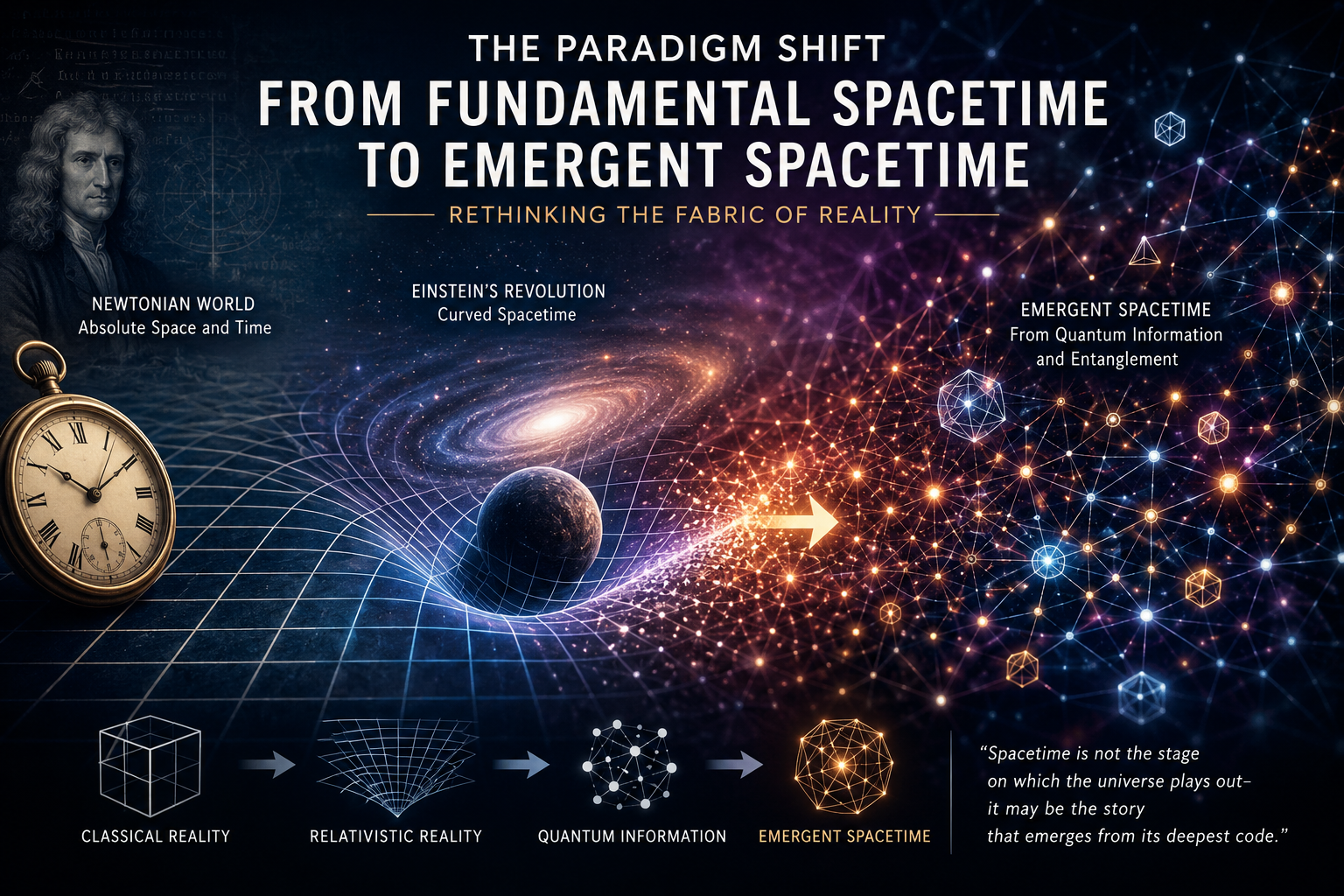
From Fundamental Spacetime to Emergent Spacetime: A Paradigm Shift in the Architecture of Reality

Abstract For more than three centuries, physics treated space and time as essential components of the universe’s fundamental architecture. Newtonian mechanics placed events within an immutable spatial arena governed by universal time. Special relativity unified space and time into a four-dimensional structure, while general relativity transformed that structure into a dynamic gravitational field. Yet the […]

Det Levde Språk: Når sannheten må erfares

(The Lived Language: When Truth Must Be Experienced) Introduction: The Chasm Between Information and Experience In an era defined by instantaneous global communication, terabytes of data transmission, and the rapid proliferation of artificial intelligence, humanity has never been more connected linguistically. Yet, paradoxically, we find ourselves grappling with a profound crisis of meaning. We exchange […]

What to Expect When Entering the Year 2030: A Comprehensive Outlook

As we approach 2030, transformative forces such as technological advances, demographic changes, and sustainability efforts are reshaping society. This article outlines key trends, challenges, and innovations across various sectors, emphasizing the importance of adaptability and collective action to navigate the future’s complexities and ensure a positive impact on humanity and the environment.

Education and Workforce Evolution: Preparing for an Emotional Economy

The emotional economy is emerging as a critical landscape where Emotional Intelligence (EQ) supersedes traditional job skills. As automation transforms work, empathy and interpersonal abilities become essential. This necessitates a shift in education towards Social-Emotional Learning (SEL) to prepare individuals for future challenges, emphasizing the importance of emotional competencies across society.

Technology and EQ: Navigating the Digital Emotional Frontier

The article explores the evolving relationship between technology and Emotional Intelligence (EQ), detailing the journey from affective computing to current applications in mental health and workplace dynamics. It raises ethical concerns about emotional data privacy and manipulation, questioning whether technology will augment our innate EQ or lead to its erosion, ultimately urging mindful engagement with these advancements.

Emotional Intelligence (EQ): The Unseen Force Shaping Our Lives and Society

Emotional Intelligence (EQ) is a crucial skill encompassing the ability to understand and manage emotions, influencing personal and professional success. Its importance has surged in today’s rapidly changing world, affecting mental health, workplace dynamics, and cultural integration. As EQ evolves, it promises a more empathetic society, driven by education and leadership.

Digital Vikings: How Nordic Heritage Inspires Global Tech Breakthroughs

The article explores the legacy of Vikings in shaping modern technology through the ethos of resilience, community, and sustainability. Jarlhalla Group embodies this “Digital Viking” spirit by merging art, technology, and Nordic heritage to promote innovative, collective solutions. Notable examples like Spotify and Ericsson highlight Scandinavia’s influence on global tech advancements.

The Power of Impact Investing 3.0: How Community-Led Innovation Is Shaping Scandinavia

Impact Investing 3.0 represents a transformative shift in how investments are made, prioritizing community-led initiatives in Scandinavia. This model emphasizes collaboration, sustainability, and systemic change, empowering local communities to design solutions. Non-profits like Jarlhalla Group play vital roles in bridging investors with grassroots efforts, fostering enduring impacts across various sectors.

Neomodernism: A Philosophical Counterpoint to Postmodernism

Neomodernism is an intellectual movement that critiques postmodernism while continuing modernist ideals. It champions universalism, critical inquiry, and objective truth, advocating for shared human rights beyond cultural relativism. Emphasizing ethical clarity and human-centric values, neomodernism influences various fields, promoting social justice and transformative frameworks in society and law.

Confucius: The Enduring Philosopher Guiding Eastern Civilization’s Ethos and Governance

Confucius, born in 551 BCE in China, profoundly influenced governance and ethics through his teachings, which formed the basis of Confucianism. His philosophy stresses moral cultivation, social harmony, and the role of virtue in leadership. Despite historical criticisms, his ideas remain relevant today, promoting personal growth and ethical discourse across cultures.

The Vedas: Foundations of Spiritual Knowledge and Civilization in Ancient India

The Vedas, ancient texts composed in Vedic Sanskrit, form the spiritual foundation of Hinduism, embodying cosmic knowledge and wisdom. Divided into four texts—Rigveda, Yajurveda, Samaveda, and Atharvaveda—they include mantras, rituals, and philosophical dialogues. Their timeless significance influences Indian society and culture, promoting spiritual inquiry and harmony.

Understanding “Mind Over Matter”: Power, Perception, and Possibility

The phrase “mind over matter” reflects a philosophical and psychological exploration of consciousness’s influence on the physical world, tracing its origins from ancient texts to modern neuroscience. It encompasses interpretations across disciplines, potential applications in health and education, while also presenting skepticism about its limits and ethical implications.

Aristotle: The Pioneer of Western Philosophy and Scientific Exploration

Aristotle (384–322 BCE) profoundly influenced Western philosophy and science through his diverse works in logic, metaphysics, ethics, and natural sciences. A student of Plato and tutor to Alexander the Great, he established foundational concepts like syllogistic logic and virtue ethics, shaping disciplines from biology to political theory, whose legacies persist today.

Plato: Shaping Western Philosophy and Cultivating Timeless Ideas for a Thoughtful Life

Plato, a pivotal figure in Western philosophy, shaped key domains such as metaphysics, ethics, and politics through his dialogues and the founding of the Academy in Athens. His Theory of Forms and concepts like the Allegory of the Cave illustrate profound epistemological ideas. His influence endures, affecting modern philosophy and various disciplines.

The Old Testament: Origins, Structure, and Enduring Significance

The Old Testament, foundational to Judaism and Christianity, consists of diverse writings reflecting ancient Israelite heritage and interactions with neighboring cultures. Comprised of various literary genres, it spans a millennium of composition. Its themes, including covenant, justice, and wisdom, continue to influence theology, culture, and moral philosophy today.

Hesiod’s Works and Days: A Timeless Blueprint for Ethical Living and Agrarian Wisdom

Hesiod’s “Works and Days” (circa 700 BCE) is a didactic poem addressing themes of labor, justice, and divine order amidst Greece’s agrarian crisis. Interweaving myth with practical advice, it advocates for honest work and moral living, critiques elite injustice, and offers a proto-ecological perspective, resonating with modern audiences facing similar challenges.

The Epic of Gilgamesh: A Timeless Masterpiece of Human Aspiration and Mortality

The Epic of Gilgamesh, the oldest known epic, originates from ancient Mesopotamia and reflects profound human concerns about mortality, knowledge, and meaning. Through its complex narrative of friendship, existential crises, and the quest for immortality, it conveys timeless themes of life, civilization, and divine justice, resonating with contemporary readers.

A Personal Ode to Flavor: Why My Favorite Restaurant Redefines the Dining Experience

The essence of a favorite restaurant goes beyond food, embodying memories, atmosphere, and personal connections. It thrives on community appreciation, ethical sourcing, and intimate service, transforming dining into a soulful experience. This place becomes a sanctuary of creativity and authenticity, merging culinary excellence with emotional resonance, ultimately shaping personal identity.

The Egyptian Book of the Dead and the Texts of the Way of Life: Wisdom, Myth, and the Journey Beyond

The Egyptian Book of the Dead and Texts of the Way of Life is an anthology of ancient Egyptian writings, edited by Saphinaz Amal Naguib and Eldrid Johansen. It explores spiritual, ethical, and philosophical insights from Old Kingdom to Ptolemaic period, emphasizing remembrance, ethical living, and the afterlife, offering timeless guidance across cultures.

The Dispute Between a Man and His Ba: Egypt’s Earliest Dialogue on the Soul, Suffering, and Mortality

Explore the psychological and poetic depths of The Dispute Between a Man and His Ba, an ancient Egyptian text that delves into themes of suffering, mortality, and the quest for meaning. This Middle Kingdom masterpiece, recorded on Papyrus Berlin, offers a timeless introspection on the human soul’s internal struggle and the ethics of self-destruction.

Decoding Machiavelli’s The Prince: Power Dynamics and Political Strategy in the Renaissance

Niccolò Machiavelli’s The Prince is a seminal 16th-century political treatise that analyzes power dynamics, focusing on pragmatic strategies for acquiring and maintaining authority, often disregarding moral constraints. Through a lens of realpolitik, it challenges the moral idealism of past political thought, asserting that effectiveness often supersedes virtue in governance.

Share with