
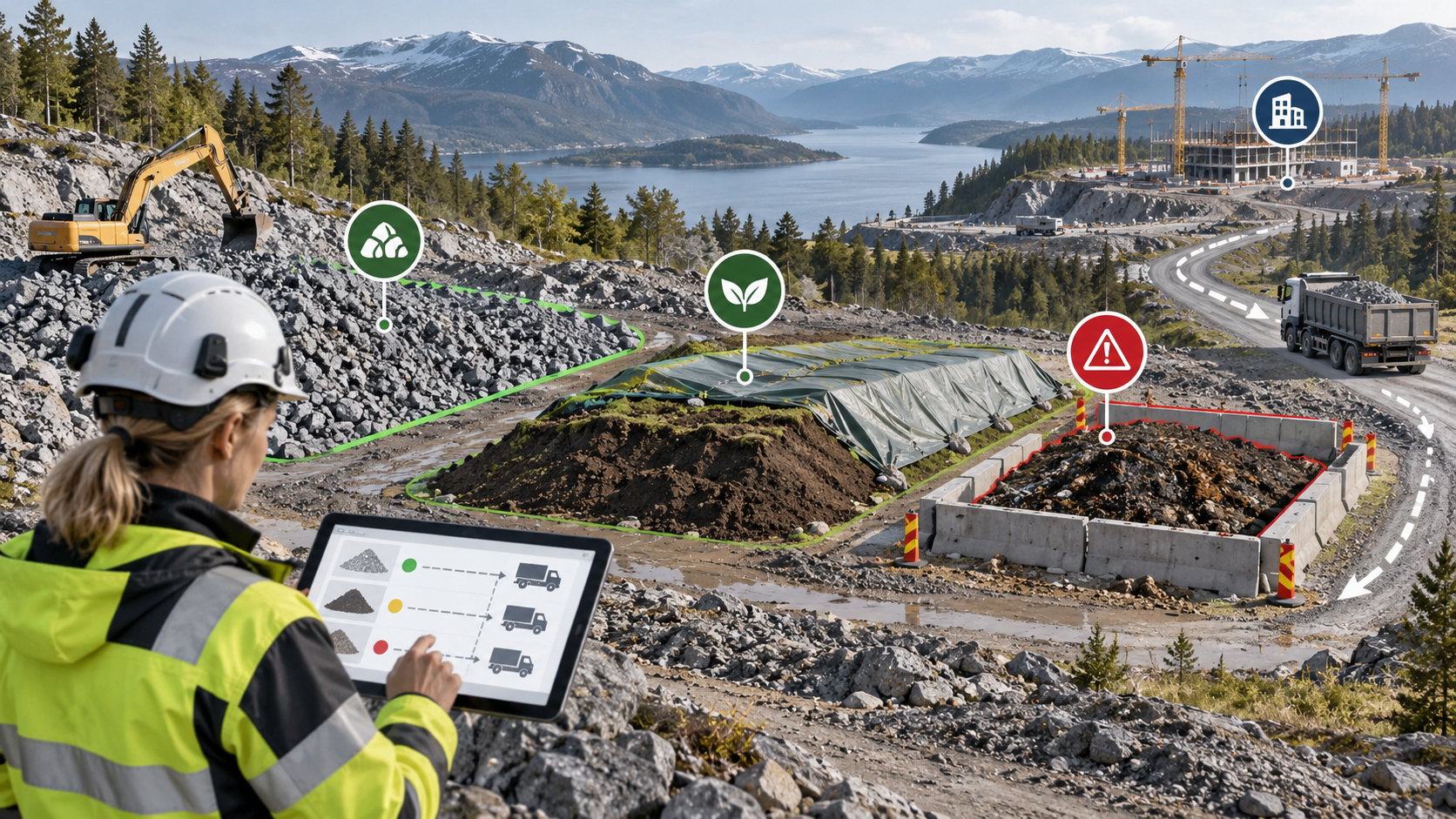
Circular construction is not only about salvaging beams and bricks. It also begins beneath the foundations, where enormous quantities of soil and rock move between building sites, storage yards and disposal facilities.
Introduction: the material nobody puts on the mood board
A construction site may spend months specifying low-carbon concrete, recycled steel and bio-based insulation. Yet the first major material decision can happen before a single structural component is installed: what should happen to the soil and rock excavated from the ground?
Some excavated material is unsuitable for reuse. Some is contaminated. Some has the wrong grain size, moisture condition or geotechnical properties. But other material could replace virgin aggregates or engineered fill in a nearby project—provided that the destination, quality and legal basis are established.
This is not a small niche in Norwegian construction. The Geological Survey of Norway (NGU) describes annual use of approximately 60 million tonnes of sand, gravel and crushed rock in construction and civil engineering. The figure refers to these mineral aggregates, not to all excavated surplus material, and should not be confused with an estimate of reusable soil. [1]
The important question is not simply how much material leaves a site. It is whether the project can demonstrate that a particular batch is suitable, needed, legally managed and environmentally preferable at its destination.
1. Why excavation creates a coordination problem
A project may have a surplus of rock during the excavation phase but need specified granular material for drainage or road sub-base months later. Another site a few kilometres away may need fill today but cannot accept deliveries after its earthworks are complete.
Material quality and timing therefore matter as much as total volume.
A SINTEF material-flow analysis of circular mass management identifies limited storage space, mismatched material quality, insufficient local processing capacity and poor coordination between projects as practical obstacles. It argues for better knowledge of material flows at national, regional and project levels. [2]
NGU’s March 2025 summary of the research emphasises early geological mapping, shorter transport distances, local reception facilities and better shared data. The researchers specifically identify uncertainty about material properties, timing and location as barriers to reuse. [3]
A circular strategy therefore needs to be designed before excavation begins—not added as a disposal solution after the trucks have arrived.
2. Clean does not mean suitable
Excavated material should never be treated as one uniform commodity.
Topsoil, peat-rich soil, clay, silt, sand, gravel and blasted rock have very different functions. A material may be environmentally acceptable but technically unsuitable for a specified layer.
The Norwegian Environment Agency notes that grain size, fine-particle content, homogeneity and organic content influence properties such as stability, bearing capacity, drainage, frost susceptibility and suitability for vegetation or agricultural soil. [4]
A geotechnical review may therefore need to address, as relevant to the proposed use:
- particle-size distribution, fines and grading;
- moisture condition, compaction and achievable density;
- strength, deformation and bearing capacity;
- frost sensitivity, drainage and hydraulic behaviour;
- organic content, durability and potential chemical reactions.
These are examples of project-dependent acceptance characteristics, not a universal mandatory test schedule. The appropriate tests and thresholds must come from the actual engineering specification, applicable standards and competent professional assessment.
The design principle is straightforward: match a documented material to a documented function. Do not redesign the function merely to find somewhere to place unwanted material.
3. Environmental screening comes before the reuse claim
Technical suitability alone is insufficient.
Norwegian guidance distinguishes non-contaminated soil and rock from contaminated materials, while recognising that even material not classified as contaminated may cause environmental harm at a particular receiving location. [5]
The Environment Agency also identifies special considerations for acid-generating rock, residues associated with blasted rock, and the possibility of pollution bound to fine particles. These risks require site-specific assessment rather than assumptions based on appearance. [5]
Where contaminated ground is involved, excavation plans and waste handling must follow the relevant requirements. The Environment Agency’s guidance explains that contaminated surplus material transported outside the intervention area is treated as waste, with specific rules for lawful treatment or disposal. [6]
There is a biological dimension too. Soil movement can spread invasive alien species. The Environment Agency explicitly calls for due care when excavating, transporting or importing soil that may contain such organisms. [6]
A credible material record therefore needs to answer two independent questions: Can the material perform the engineering function? and Can it be used at this destination without unacceptable environmental consequences?
Neither answer can be inferred from the other.
4. Reuse is not the same as convenient dumping
Norwegian law makes the distinction between recovery and disposal consequential.
The Environment Agency’s M-1243 guidance states that surplus non-contaminated soil and rock from construction and infrastructure works will normally be considered commercial waste. Under the Pollution Control Act, its handling is subject to requirements intended to protect the environment and enable recovery. [7]
The agency explains that using such material as fill can count as recovery when it genuinely replaces other material that would otherwise have been obtained and used. Its assessment considers whether the receiving project was planned independently of the surplus, whether the quantity is proportionate to the real need, and whether the material is suitable. [4]
A new embankment created mainly because a contractor has excess spoil is not automatically a circular-economy success.
There are important legal nuances: the Environment Agency’s guidance also discusses circumstances in which non-contaminated surplus material planned with certainty for use in another project before excavation may fall outside the waste definition. Regulatory status must therefore be assessed for the actual material flow rather than decided by a marketing label. [6]
Requirements under planning, pollution, nature-conservation and other relevant legislation can apply in parallel. The responsible parties should establish the correct permitting route with the relevant authorities before moving material. [7]
5. The five-gate reuse assessment
A practical project can use five sequential decision gates. This is an editorial proposal, not a statutory Norwegian approval scheme.
Gate A — Origin and classification. Record where the material comes from, the relevant ground investigation, its geological description, estimated quantity and excavation period. Identify uncertainty and whether further investigation is required.
Gate B — Environmental acceptability. Establish contamination status and other environmental hazards, including potential invasive species and receiving-site sensitivities. Document the applicable regulatory assessment.
Gate C — Engineering fitness. Match test evidence and material properties to a specific design function. Reject or reprocess batches that cannot meet the acceptance criteria.
Gate D — Real destination and timing. Identify an approved receiving location with a genuine need for the quantity and type of material. Confirm storage capacity, access, handling arrangements and schedule compatibility.
Gate E — Comparative impact and traceability. Compare the proposed reuse route against the credible conventional route, including necessary processing, transport, loading and potential losses. Record the decision and responsible reviewer.
The result is not a blanket ‘approved for reuse’ stamp. It is an evidence-based decision for a specific material batch, intended use and destination.
6. What a digital material passport should record
A material passport for excavated soil and rock need not begin with a sophisticated platform. A controlled spreadsheet or structured database may be sufficient for a pilot.
A useful record could include a unique batch identifier; source project and excavation zone; geotechnical and geological classification; sampling dates and laboratory references; environmental findings; expected and measured volumes; handling and stockpile locations; proposed destination and use; transport movements; acceptance criteria; permits or regulatory decisions; and final sign-off.
For larger programmes, spatial data and BIM or GIS interfaces may make material flows easier to plan. But a digital label cannot make unreliable laboratory results trustworthy, and a map pin cannot prove legal compliance.
NGU’s 2025 account of the circular mass-management research calls for better standardisation and a shared national geological information base. It is a recommendation from the research project, not evidence that such a complete mandatory national platform is already operational. [3]
Data quality must precede dashboard sophistication.
7. The carbon question: compare complete routes, not just kilometres
Reuse can avoid quarrying and reduce transport, but neither benefit is automatic.
Consider a hypothetical project with 1,000 tonnes of suitable excavated granular material. Route A sends it to a distant disposal site and buys an equivalent virgin product. Route B delivers it to a nearby project where it replaces material that would otherwise be purchased.
The climate comparison should account for both routes: extraction or processing of replacement material, handling, storage, screening or crushing, transport legs, return loads, and any relevant additional operations. If material must be hauled to a processing facility and then transported again, those movements belong in the calculation.
A transparent screening calculation might use:
Transport emissions = transported tonnes × distance travelled × applicable emissions factor
But this is only one component of a defensible comparison. The emissions factor must correspond to the actual vehicle, load, energy source and accounting method. A full project assessment should use a defined system boundary and avoid double-counting avoided impacts.
SINTEF’s mass-flow analysis identifies fewer handling steps, shorter journeys and improved return loads as potential emission-reduction opportunities under suitable conditions. It does not establish a universal percentage saving for every reuse project. [2]
If a project cannot show that material really displaces a conventional input, its avoided-emissions claim should remain unverified.
8. The overlooked risk: the receiving landscape
The cheapest route may not be the most sustainable.
A fill project can disturb habitats, change drainage, affect watercourses or consume valuable land. A stockpile can generate dust, sediment runoff or traffic impacts. A biologically unsuitable soil transfer can introduce invasive species.
These are not peripheral matters. They are part of the environmental decision.
The Environment Agency notes that even soil and rock not classified as contaminated can cause environmental harm when placed in particular settings. [5] This means that reuse must be evaluated as an intervention in a landscape, not simply as a transfer of material between balance sheets.
A credible circular construction strategy should prefer avoiding unnecessary excavation in the first place, then assess safe on-site use, suitable nearby recovery, processing and lawful disposal according to actual conditions.
9. A Nordic procurement model that could work
The opportunity is to move mass management into the design and procurement process.
A developer could require an early material-flow forecast, an evidence-based classification plan, a list of possible local recipients and a decision log for each major material stream.
An engineer could define performance criteria for prospective uses. An environmental specialist could establish sampling and regulatory requirements. A contractor could propose logistics, stockpile management and traceability. Municipal or regional actors could help coordinate needs across projects where the relevant permissions and infrastructure exist.
Rogaland offers a useful illustration of public-sector interest. An Environment Agency Klimasats project records that Rogaland County Municipality investigated central reception and recycling facilities for surplus construction material between 2019 and 2022. Its published project summary said no central facility had yet been established at the time of reporting; that historic statement should not be treated as a verified 2026 operational status. [8]
The lesson is not that one facility solves the problem. It is that geology, logistics, planning and demand need to be considered together.
10. A 30-day evidence pilot
A small regional pilot could test the approach without claiming an unproven breakthrough.
During the first week, select one upcoming excavation and one real receiving project. Gather available ground investigations and identify likely material categories.
In the second week, define engineering acceptance criteria, environmental checks and legal responsibilities. Flag uncertain material as ‘not cleared’ rather than assuming it is reusable.
In the third week, assess quantity, timing, stockpile requirements and transport routes. Prepare a baseline comparison with the conventional supply-and-disposal option.
In the fourth week, document a go/no-go decision for each candidate batch, together with test coverage, unresolved issues and a clear audit trail.
Measure actual outcomes only when they occur: tonnes genuinely recovered, virgin material demonstrably displaced, transport activity, environmental incidents, costs and calculated emissions under a stated method.
This pilot is a proposed methodology. It is not a completed Jarlhalla, SustainArc or Terratek case study.
Conclusion: the next circular building resource is already under our feet
The circular construction conversation often begins with visible products: reclaimed steel, timber, bricks and facade panels.
But soil and rock can dominate the earliest logistics of a project, and decisions made before excavation can determine whether those materials become resources or costly waste streams.
Research from SINTEF and NGU points toward the same practical need: better early information, better coordination and the right material for the right purpose. [2][3]
The Norwegian regulatory framework adds an essential safeguard. Reuse must be genuine, suitable and environmentally responsible—not a convenient name for disposal. [4][7]
The future of circular mass management will not be measured by how many tonnes are labelled ‘reused’. It will be measured by how much verified value is retained without compromising engineering performance, legal compliance or the landscape receiving the material.
Before asking where to dump the ground, ask what it could responsibly become.
References — checked 28 October 2026
- Geological Survey of Norway (NGU). Bruk av sand, grus og pukk som byggeråstoffer. Undated reference page; accessed 28 Oct 2026. Official NGU source.
- SINTEF. Sirkulær masseforvaltning. Materialstrømsanalyse av overskuddsmasser fra bygg- og anleggsnæringen. Research report; publication record accessed 28 Oct 2026. SINTEF publication.
- NGU. Ønsker økt ombruk av byggeråstoffer. Published 28 March 2025. NGU research news.
- Norwegian Environment Agency (Miljødirektoratet). Gjenvinning av jord- og steinmasser. Official M-1243 guidance; accessed 28 Oct 2026. Recovery criteria.
- Norwegian Environment Agency. Jord- og steinmasser som ikke er forurenset. Official guidance; accessed 28 Oct 2026. Classification and environmental risks.
- Norwegian Environment Agency. Håndtere og disponere gravemasser. Official contaminated-ground guidance; accessed 28 Oct 2026. Excavated-material handling.
- Norwegian Environment Agency. M-1243: Disponering av jord og stein som ikke er forurenset. Last updated 14 August 2025; accessed 28 Oct 2026. Regulatory guidance.
- Norwegian Environment Agency / Klimasats. Sentrale mottaksanlegg for overskuddsmasser (Rogaland County Municipality; project 2019–2022). Historical case summary; accessed 28 Oct 2026. Klimasats project.