
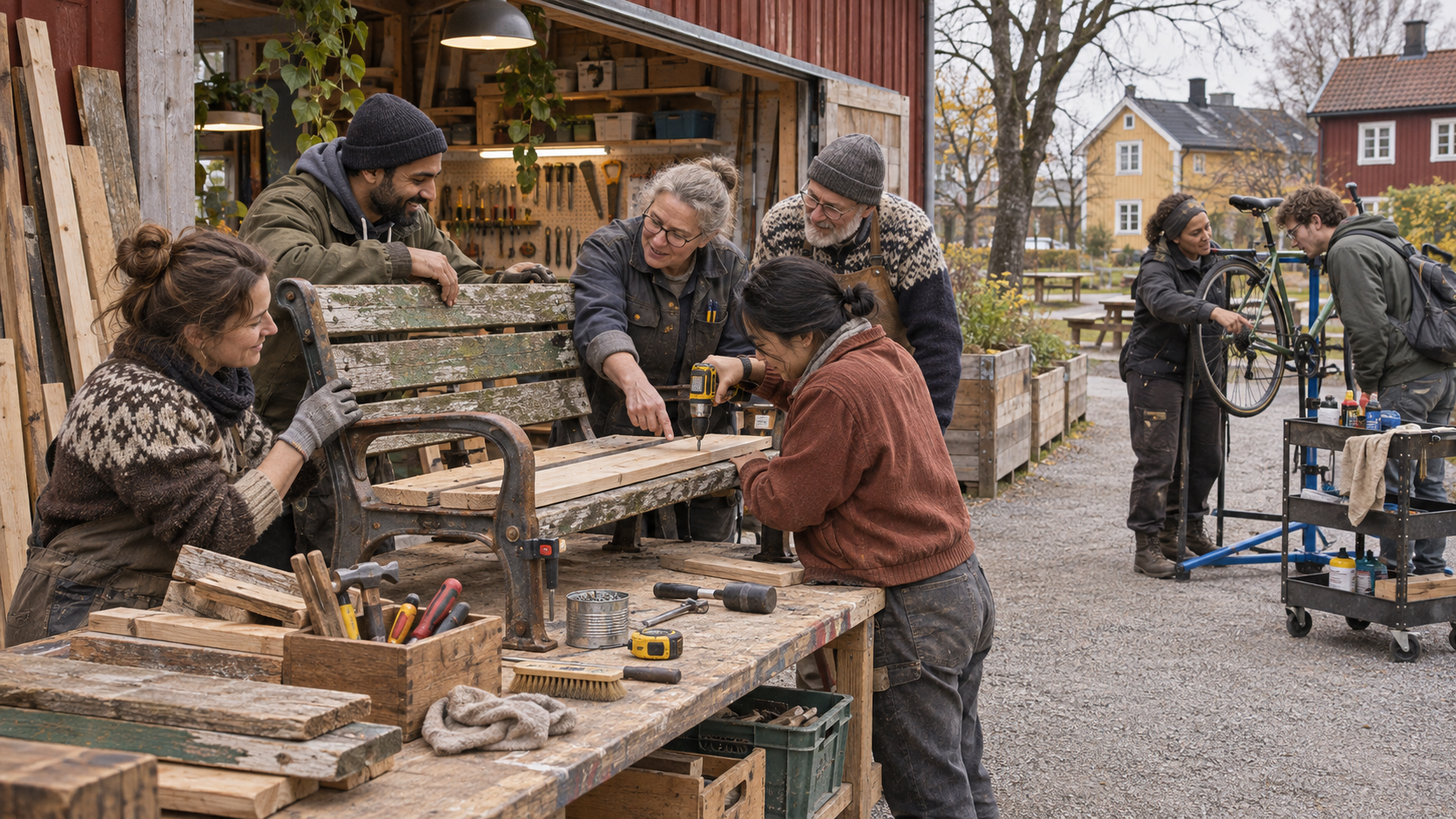
Regeneration does not have to begin with a landmark building. It can begin with a broken bench, a local workshop and a decision that residents genuinely control.
Start with a place, not a platform
Imagine a neighbourhood where a community room needs maintenance, bicycles are waiting for repair and useful building materials are being discarded. People have practical skills, but there is no simple way to connect them with local needs.
A digital platform might help coordinate the work. It cannot, by itself, establish trust, grant permission to repair public property or ensure that work is safe.
That is why SamfunnsBro could test a Neighbourhood Repair Lab: a small, time-limited, community-led pilot combining hands-on maintenance, repair education, material reuse and transparent local decision-making.
This is a proposed Jarlhalla editorial model. It is not an announcement of an operating lab, a funded programme or a partnership already secured.
Why participation must influence decisions
The OECD’s 2024 Survey on Drivers of Trust in Public Institutions examined how people experience institutional responsiveness, openness, integrity, fairness and reliability. Its findings concern public institutions, not repair labs, and cannot be used to claim that a particular community workshop will increase trust. They do, however, reinforce the importance of treating public feedback as something decision-makers respond to, rather than merely collect. [1]
A repair lab should therefore publish a simple decision trail: what residents proposed, which ideas were feasible, who made the decision and why alternatives were rejected.
For example, residents may prioritise accessible seating over a decorative installation. The project team should not silently substitute its own preference and call the result co-design.
Lessons from European place-based innovation
The European Union’s New European Bauhaus initiative connects sustainability, inclusion and quality of experience in everyday places. The New European Bauhaus Toolbox offers structured activities for identifying local challenges, exploring options and refining proposals. [2]
In its 2026 Connect NEB and Co-create NEB call, the EIT Community distinguished community-led experimentation from partnerships that deliver visible improvements to public spaces. That distinction is useful for a pilot: listening sessions and prototype workshops are not equivalent to completed physical improvements. [3]
The EU regulation establishing the European Solidarity Corps also describes volunteering priorities spanning inclusion, green and digital transitions, and democratic participation. These programmes provide policy context, not evidence that a SamfunnsBro pilot qualifies for funding or will achieve the same outcomes. [4]
A six-gate delivery model
Gate 1 — Listen and define. Invite residents, local associations, property owners, accessibility advocates and skilled tradespeople. Record needs in accessible language, including feedback from people who cannot attend meetings. Select one bounded problem, not an entire neighbourhood transformation.
Gate 2 — Establish permission and responsibility. Confirm ownership of the site or object, written permission, insurance, safeguarding requirements and the responsible project lead. Activities affecting electrical installations, load-bearing elements, fire safety or other regulated work must be referred to appropriately qualified and authorised professionals. Volunteering is not a substitute for legal compliance.
Gate 3 — Design together. Present two or three feasible options with cost, accessibility, maintenance and environmental implications. Explain how resident feedback changes the chosen design. A physical mock-up or simple 3D model can help people assess scale and usability.
Gate 4 — Map materials and skills. Record available tools, donated materials, safety equipment, storage and mentor capacity. Do not treat an item as reusable merely because it is free: condition, contamination, traceability and suitability matter. Material records should distinguish confirmed reuse from material merely collected for possible reuse.
Gate 5 — Deliver and verify. Begin with low-risk, supervised tasks such as repairing loose furniture, maintaining non-critical fixtures or teaching basic bicycle maintenance. Use task-specific risk assessments, tool checks and clear stop-work authority. Record defects and corrective actions before declaring a result complete.
Gate 6 — Transfer ownership. Agree who maintains the result, pays for consumables and handles future defects. Without a maintenance owner, an attractive one-day event can become an abandoned asset.
These six gates are an original proposed management framework, not an EU or Norwegian standard.
Measure what changed, not just who attended
A pilot should distinguish activity, output and outcome.
| Dimension | Proposed measure | Evidence |
|---|---|---|
| Participation | Number of participants and repeat visits | Consented, aggregated attendance |
| Inclusion | Whether barriers to participation were identified and addressed | Accessible feedback and action log |
| Physical output | Items repaired and accepted for use | Before/after condition record |
| Circularity | Mass or count of verified reused materials | Material inventory with exclusions |
| Learning | Skills demonstrated during supervised activities | Mentor observations, not automatic certification |
| Governance | Share of resident proposals with documented decisions | Public decision register |
| Durability | Condition after 30 and 90 days | Follow-up inspection |
Avoid converting every repaired item into an invented carbon-saving number. Any emissions comparison needs a defensible baseline, material quantities, transport assumptions, replacement lifetime and clear boundaries. If the data are insufficient, report physical quantities and uncertainty instead.
Privacy and dignity are design requirements
A community project may involve young people, jobseekers or vulnerable residents. It should not require public disclosure of personal circumstances to participate. Collect the minimum personal data needed for safe delivery; provide meaningful consent choices for photographs and testimonials; set retention periods; and keep safety records separate from promotional material.
A skills passport, if later introduced, would be an optional evidence mechanism, not a condition for joining the lab. The previously published SamfunnsBro skills-passport proposal explains why participation records and formal qualifications must remain distinct.
A 30-day pilot that can fail safely
Week 1: Identify one host organisation and a candidate site; interview residents; document the problem and permissions.
Week 2: Select one low-risk activity, complete risk and accessibility reviews, confirm mentors and material provenance.
Week 3: Run a supervised repair session, collect non-sensitive operational evidence and publish a short decision log.
Week 4: Inspect outputs, gather feedback, publish actual costs and decide whether to repeat, modify or stop the experiment.
This timeline is an illustrative planning target, not a promise that approvals or procurement can be completed within four weeks. If permissions or safety controls are incomplete, the physical activity must wait.
Where Jarlhalla could add value
Jarlhalla’s engineering, digital modelling and sustainability interests could support three bounded contributions: an accessible project brief, a lightweight materials and decisions register, and a transparent evidence dashboard. SamfunnsBro could help connect community organisations with mentors and participants.
The ambition should not be to own the neighbourhood’s decisions. It should be to make decisions more informed, practical and accountable.
Build trust through useful work
A successful pilot is not necessarily the one with the most participants or the most impressive photographs. It is the one where residents can identify a genuine need, see how decisions were made, use the result safely and know who will maintain it.
That is a modest starting point for regeneration—and a more credible foundation for scaling than launching a platform before understanding the place.
Related reading: The Social Value of a Building Begins Before Construction.
Sources and factual boundaries
- OECD (10 July 2024), Survey on Drivers of Trust in Public Institutions – 2024 Results. Context for responsiveness and public trust; no causal claim about repair labs.
- European Commission / BUILD UP (10 July 2024 listing), New European Bauhaus Toolbox. Co-design and project-development framework.
- European Institute of Innovation and Technology (2026 call), Connect NEB & Co-create NEB 2027. Describes community-led pilots and place-based transformation; not evidence of eligibility or funding for SamfunnsBro.
- European Parliament and Council (20 May 2021), Regulation (EU) 2021/888 establishing the European Solidarity Corps Programme. Programme priorities and implementation context.
- European Commission (1 April 2025), Evaluation of the European Solidarity Corps. Evidence on volunteering, community engagement and programme constraints.
- European Commission / CINEA (30 June 2026), LIFE projects that build the New European Bauhaus. Examples of local demonstrators; not proof of performance for this proposed pilot.
Editorial caveat: No specific Norwegian building or safety exemption is asserted. Site-specific regulatory, contractual, insurance and accessibility requirements must be checked by responsible parties before any physical work.