
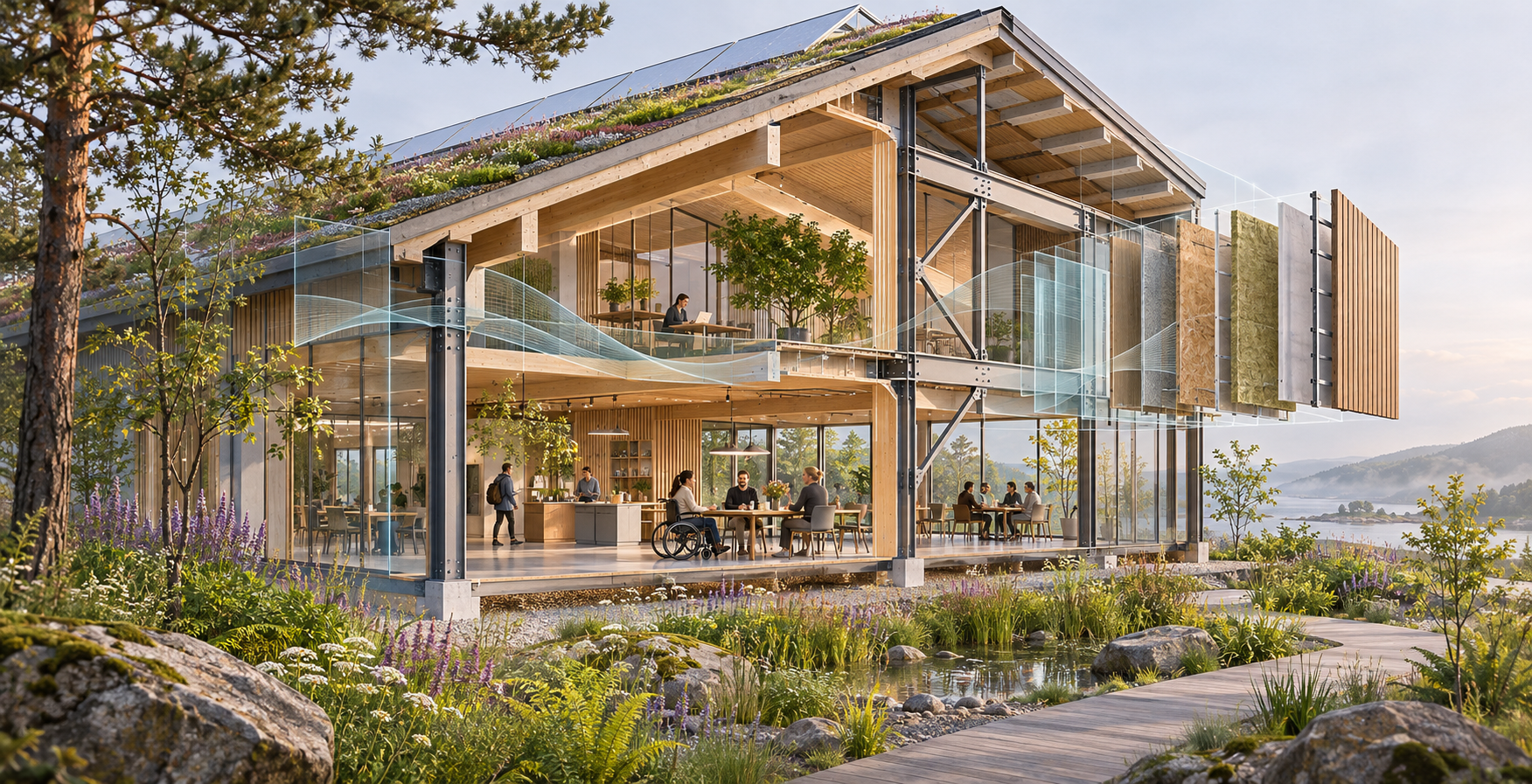
Building for the future demands more than lower emissions. It demands decisions that connect structural integrity, resource cycles, ecological function, operational intelligence and human value.
Why another building framework?
A building can achieve good energy performance while using materials that cannot be repaired, separating occupants from healthy outdoor environments, or transferring costs to future owners. A technically efficient project is not automatically circular. A circular component is not automatically safe. A green landscape is not automatically a functioning ecosystem.
These distinctions are a starting point for the proposed Jarlhalla Regenerative Building Model. It is a practical way to organize decisions across five related questions, not an alternative to applicable codes, standards, independent design review or recognized life-cycle assessment methods. Where our earlier article on regenerative architecture (https://jarlhalla.com/building-the-future-regenerative-architecture/) explored the vision, this one turns it into a decision method.
The sector’s scale makes integrated decisions important. The UN Environment Programme’s 2025–2026 global buildings report describes an industry responsible for around 37% of global CO₂ emissions and nearly half of global material extraction, with its report’s specific system boundaries [1]. Those global figures are context; they do not quantify any individual project’s impact.
1 — ENGINEERING: Can it safely and durably work?
The foundation of regenerative design is technical credibility. Structures, moisture control, fire safety, accessibility, indoor environment, maintainability and climate resilience must be evaluated against the actual project and jurisdiction.
In a Norwegian context, that means identifying the applicable TEK17 requirements, relevant standards and assigned professional responsibilities—not asking a general-purpose AI tool to pronounce a building compliant.
Decision test: What is the governing performance requirement, who can verify it and where is the controlled evidence?
Possible evidence: approved calculations, quality plans, technical specifications, measured performance and independent review as needed.
2 — MATERIALS: Can we use less, use longer and recover more?
Materials connect building performance to upstream resource use and future reuse. Options include avoiding unnecessary components, using durable assemblies, documenting products, assessing reuse and designing for disassembly.
ISO 20887:2020 provides principles and guidance on design for disassembly and adaptability. It does not create a universal pass mark or guarantee reuse of a specific structural component [2].
A proposed material strategy should therefore record provenance, technical suitability, expected service life, repairability, reversible connections and end-of-life scenarios. Where environmental comparisons are made, define equivalent functional performance and life-cycle boundaries.
Decision test: Can the material and its documentation support safe use now—and a realistic next use later?
3 — NATURE: Does the project understand its ecological setting?
Regenerative ambition must be tied to site-specific evidence. A building affects hydrology, soil, vegetation, habitats, heat, drainage and the landscape beyond its plot boundary.
The EU Nature Restoration Regulation, in force since 18 August 2024, represents a broader policy movement toward measurable ecosystem restoration [3]. It should not be treated as automatically imposing identical project duties in Norway; applicability must be checked separately.
A site strategy can document pre-project ecological conditions and define measurable interventions for stormwater, habitat connectivity, native planting and long-term maintenance.
Decision test: What ecological baseline exists, what change is expected and who will monitor whether it occurs?
4 — DATA: Can the evidence survive beyond handover?
Models and reports become more useful when their sources, versions and ownership remain traceable. BIM, IFC exchange, material inventories, inspections and selected operational sensors can help owners understand buildings over time.
Data alone is not intelligence. A static model is not automatically a digital twin, and an AI-generated recommendation is not engineering verification. The relevant question is whether the system helps authorized people make better decisions using trustworthy information.
Decision test: What decision can be improved using this dataset, how do we test the improvement and who is accountable?
Possible evidence: a controlled asset-information model, data dictionary, quality checks, version history, monitoring and governance.
5 — PEOPLE: Who receives the benefits and bears the costs?
Buildings shape health, accessibility, opportunities for skills development, maintenance work, neighborhood resilience and long-term affordability. A regenerative claim is incomplete if human consequences are not examined.
Public procurement, apprenticeship opportunities, inclusive design and user engagement can create social value, but each must be defined with clear scope and evidence rather than assumed to follow from an inspiring concept.
Decision test: Which people are affected, how were they consulted and which outcomes can actually be observed?
Why the five parts must be assessed together
Consider a proposed reuse of structural timber. The materials dimension might show reduced demand for virgin resources. Engineering still needs to verify structural properties, moisture condition and intended use. Nature analysis considers site effects and sourcing. Data establishes material provenance and the inspection trail. People determine whether the solution is buildable, maintainable and useful for those involved.
A strong result in one dimension cannot compensate for an unresolved high-consequence defect in another.
From philosophy to a decision matrix
For each project option, create one row per dimension:
| Dimension | Key question | Candidate indicator | Evidence owner |
|---|---|---|---|
| Engineering | Is performance verified? | Open critical technical issues | Design / qualified reviewer |
| Materials | Is resource use defensible? | Functional-unit LCA, reuse suitability | Materials / LCA team |
| Nature | What happens to ecology? | Site baseline and monitored outcome | Ecological specialist |
| Data | Can decisions be traced? | Versioned evidence completeness | BIM / information manager |
| People | Who benefits? | Accessibility and agreed social indicators | Project owner / stakeholders |
The European Commission’s Level(s) framework provides a common language for life-cycle sustainability assessment with indicators spanning greenhouse gases, circular material flows, water, indoor environmental quality and resilience [4]. Jarlhalla’s five-part model is an editorial and project-governance synthesis; Level(s) is an external framework and should be used on its own terms.
The matrix should have hard safety and compliance gates. It must not allow attractive performance in one domain to conceal a critical failure in another. Any composite scoring or weighting would require explicit context-specific justification.
How the Jarlhalla ecosystem can contribute
- Taksdal BT: buildability, technical documentation and risk-focused project intelligence.
- SustainArc / BioLab: architecture, material options and inquiry into bio-based performance.
- Terratek: applied technology, engineering methods and prototype development.
- MykoKnoks / Nature Intelligence: field observations and ecological research questions, subject to relevant scientific validation.
- SamfunnsBro: skills, participation and social-value design.
- Jarlhalla Group: integrated research communication, data architecture and cross-disciplinary project coordination.
This is a map of proposed capabilities, not a statement that all services, credentials, collaborations or measured outcomes have already been commercially delivered.
A proposed first assessment
A practical starting engagement can be scoped around a real project decision:
- Map the asset, stakeholders and technical decision.
- Establish baseline evidence across five dimensions.
- Identify critical unknowns, regulatory duties and unacceptable risks.
- Compare options using appropriate specialist methods, not an invented universal score.
- Deliver a prioritized decision record with data gaps, owners, next actions and testable hypotheses.
The outcome should be a better, auditable decision—not a promise of an unverified regenerative benefit.
The regenerative challenge
The most important question is not whether a project can carry a sustainability label. It is whether the team can demonstrate durable technical performance, responsible material choices, a credible ecological response, traceable information and tangible human value.
Engineering → Materials → Nature → Data → People is Jarlhalla’s proposed way to keep those questions together, from first concept to operation and eventual reuse.
Explore a Research Partnership / Discuss a Project: Jarlhalla welcomes bounded, evidence-led conversations about how these five dimensions can inform a real decision.
References
- UNEP / GlobalABC (19 May 2026), Global Status Report for Buildings and Construction 2025–2026. Boundaries and terminology must be checked before transferring global estimates to projects.
- ISO, ISO 20887:2020 — Design for disassembly and adaptability, reviewed and confirmed 2025.
- European Commission, Nature Restoration Regulation.
- European Commission, Level(s) framework and macro-objectives.
Featured image: AI-generated conceptual editorial illustration; not a real project, certification or construction detail for execution.