
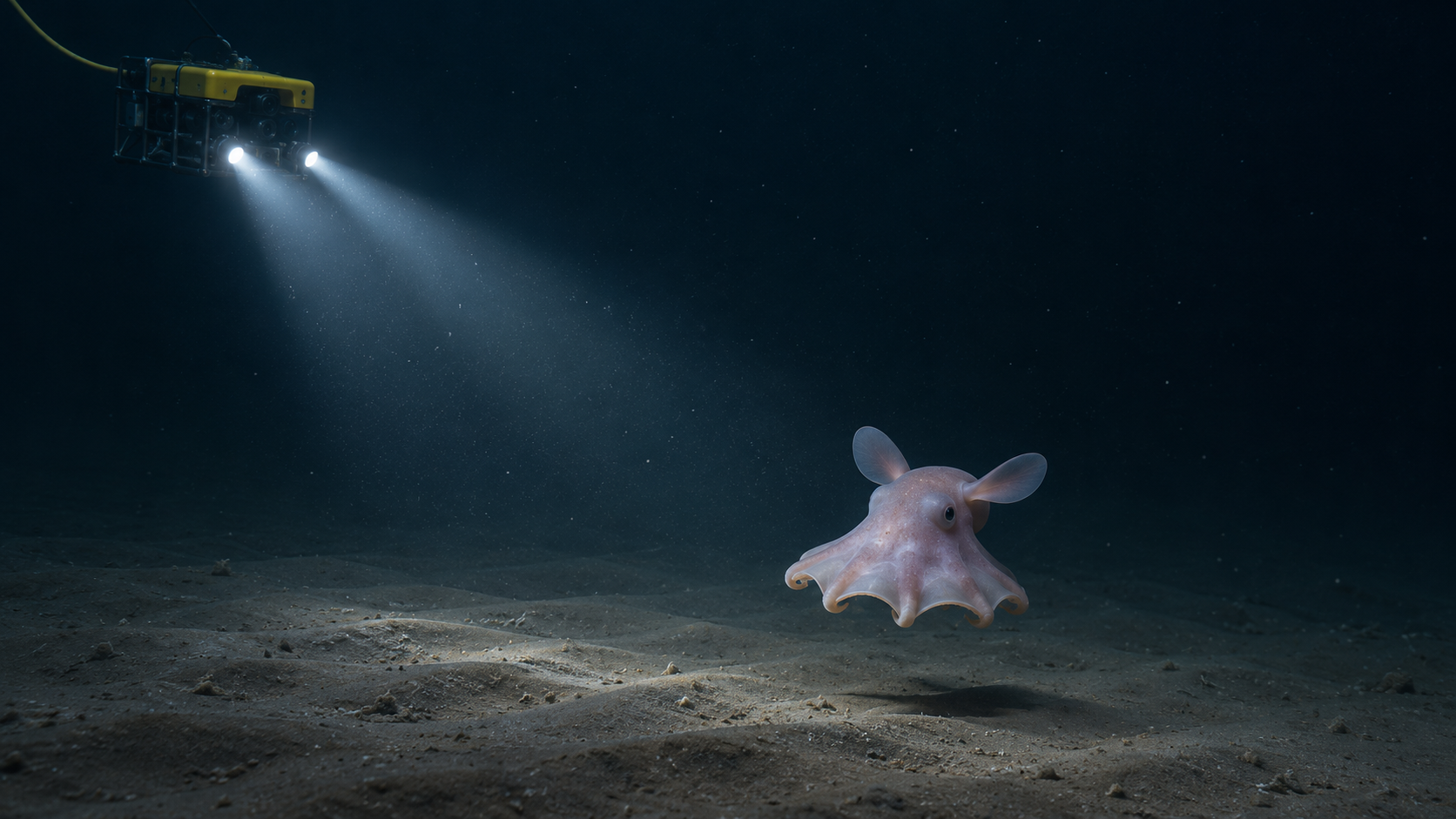
Three kilometres down in the western Norwegian Sea, a camera can cross a stretch of seabed and record little more than mud. A sample from that same patch can bring up tiny crustaceans, worms and molluscs. The two observations answer different questions, and Norway’s MAREANO programme needs both.
Featured image: AI-generated illustration of an imagined deep-sea scene.
What the camera leaves out
Beate Hoddevik of Norway’s Institute of Marine Research reported in November 2026 that MAREANO had completed two cruises to deep areas in the western Norwegian Sea. Researcher Èric Jordà Molina expects the samples to yield animals new to science. An unfamiliar specimen is the start of that work. Establishing whether it belongs to an undescribed species takes comparison with existing records and specimens, and sometimes genetic evidence.
At these depths, sunlight never reaches the bottom. The lights of a remotely operated vehicle (ROV) give scientists a narrow view of the terrain and the animals large enough to register on camera. A sediment sample extends that view into the mud, where much smaller organisms live. The difference matters when interpreting survey records. A camera transect with few visible animals says little about the abundance of animals buried in the sediment.
The HMS Challenger expedition of 1872–1876 showed how much deep-sea life could be revealed by bringing specimens to the surface. Modern surveys add video and genetic sampling, so researchers can compare what they collect with what they see in place.
How MAREANO samples the seabed
MAREANO began in 2005 as a collaboration among Norway’s Institute of Marine Research, Geological Survey and Mapping Authority. The programme maps depth, seabed geology, habitats, biodiversity and contaminants. Its public maps and reports help researchers relate a biological observation to the landscape and conditions around it.
The report from the second Arctic Mid-Ocean Ridge cruise, conducted in April and May 2026, documents three complementary lines of evidence:
- Video transects show the seabed, the distribution of visible animals and the substrate they occupy.
- Box cores bring a defined patch of soft sediment aboard for examination. Researchers can sieve the sediment and identify animals that would be hard to see in the footage.
- Environmental DNA samples from water and sediment preserve traces for genetic analysis. A sequence can help flag organisms that other methods miss. Its interpretation depends on sample handling, the quality of reference databases and whether it can be linked to a specimen.
Sampling is physical work with practical limits. The cruise report records both usable cores and difficult landings. Documenting those differences helps later researchers judge whether two stations can be compared on equal terms.
A food web fed from above
In much of the deep ocean, food arrives as marine snow: sinking particles that include plankton remains and other organic debris. Much of that material is consumed or broken down before reaching the seabed. What does arrive feeds sediment communities, where microbes decompose organic matter and return some of its nutrients to forms other organisms can use.
Worms, tiny crustaceans and other sediment animals occupy different niches in that community. Animals that feed on deposits can ingest organic particles mixed into the mud. The organisms in a core therefore tell a different ecological story from a larger animal passing through an ROV’s lights.
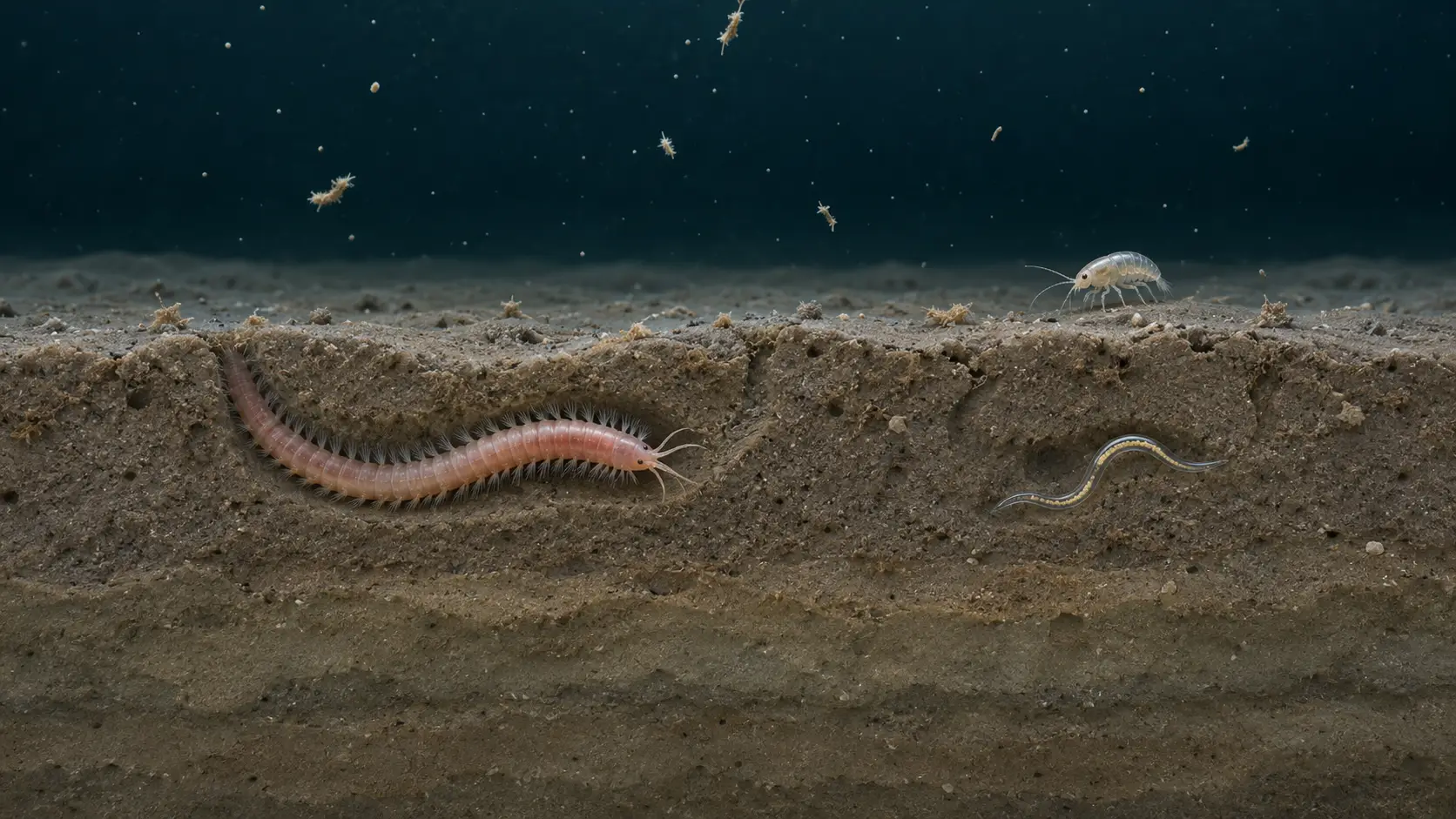
Hydrothermal vents provide a useful contrast. In 1977, researchers near the Galápagos Islands found vent communities sustained by chemosynthesis. Microbes there can use chemical energy to produce organic matter. Vent communities illustrate how profoundly the local supply of energy can shape life on the seabed. The muddy stations in the Norwegian surveys pose a different question: how much life can a patch of sediment support on the food it receives?
What a baseline can tell us
A useful baseline records where samples were taken, what each method could detect and how much variation researchers found across stations. Future surveys can then ask whether a shift in the animals observed reflects a real change, a different patch of seabed or simply a different sampling method. That distinction matters when evaluating disturbance from activities such as seabed mineral extraction.
Norway’s Ministry of Energy says the first licensing round for seabed minerals will not be announced during the current parliamentary term. The value of the surveys extends beyond that decision. The specimens, footage and station records collected now can help researchers ask better questions about future changes, whatever their cause.
The clearest result from a deep-sea survey may be a more precise account of what is still unknown. A camera records a visible animal at a particular moment. A core records a small community in one patch of mud. Keeping both records, with their locations and limits intact, gives the next expedition something it can test.